Course Introduction

AI is transforming how organisations manage everyday operations. From processing information and preparing reports to coordinating approvals, tracking tasks and managing recurring workflows, Generative AI can help organisations reduce manual effort, improve consistency and streamline business processes.

This practical course shows participants how to examine existing workflows, identify opportunities for improvement and explore how Generative AI can be incorporated into more efficient and innovative ways of working.

Build Smarter Workflows With AI In 2 Days!
Practical AI for Operations & Workflow Automation
Use Generative AI to analyse processes, reduce repetitive work, improve workflows and identify opportunities for business automation.

Course Overview

A hands-on, workflow-driven AI course designed for professionals involved in improving how work gets done across different industries.

Participants explore how Generative AI can be applied to existing business processes, identify suitable opportunities for implementation and develop practical AI-assisted approaches to improve operational efficiency.

This course is suitable for:

  • Operations Executives & Managers
  • Administrative & Corporate Support Teams
  • Process & Quality Improvement Personnel
  • Supervisors & Team Leaders
  • Project Coordinators
  • Business Owners & SME Managers
  • Professionals responsible for workflows, reporting or process improvement

Learning Units​

1. Understanding Generative AI in Business Operations

Understand the foundations of Generative AI and explore how it can be applied to operational processes across different business environments.

2. Analyse Processes & Identify AI Opportunities

Break down existing workflows, identify repetitive activities, bottlenecks and inefficiencies, and determine where Generative AI can add value.

3. Design AI-Assisted Workflows

Explore how Generative AI can support information processing, documentation, reporting, decision support and other recurring operational activities.

4. Evaluate AI Solutions, Risks & Limitations

Assess whether proposed AI applications are practical and appropriate, considering accuracy, privacy, ethics, human oversight and other implementation risks.

5. Implement & Evaluate an AI-Enabled Business Process

Develop a practical AI-assisted workflow and analyse implementation approaches through business cases and workplace scenarios.

You will gain competency in

Process & Workflow Analysis

Break down existing business processes to identify bottlenecks, repetitive work and opportunities for improvement.

Identifying AI Opportunities

Recognise where Generative AI can support operational activities and evaluate whether its use provides meaningful business value.

AI-Assisted Workflow Design

Develop practical approaches that integrate Generative AI into existing processes, documentation, reporting and information flows.

Operational Reporting & Information Analysis

Use AI to organise information, extract important insights, summarise operational data and produce structured reports.

Evaluating AI Risks & Limitations

Consider accuracy, confidentiality, ethics, human oversight and operational risks before implementing an AI-supported process.

AI Implementation & Continuous Improvement

Develop an implementation approach, evaluate outcomes and identify opportunities to further improve the workflow.

Who Is This Course For?

This course is suitable for professionals from all industries who are involved in operations, administration, process management or improving how work gets done.

It is particularly relevant if your role involves:

  • Managing recurring operational processes
  • Preparing or reviewing reports and documentation
  • Coordinating information between people or departments
  • Handling approvals, requests or administrative workflows
  • Identifying inefficiencies or process bottlenecks
  • Improving SOPs and existing ways of working
  • Exploring opportunities to introduce AI into business operations

No programming or technical AI background is required.

Prerequisite

  1. Basic computer literacy
  2. Comfortable using a web browser and common office applications
  3. Basic understanding of workplace processes
  4. No programming or previous AI experience required

Generative AI Course in Singapore

$680 (Full Fees before GST)

$204 (After estimated 70% subsidy)

payable with: SkillsFuture Credits, PSEA
SFEC available for SMEs

Duration: 2 days

Location:
Centrium Square, 320 Serangoon Road #10-03, Innovation Room

Choose AAT Training Hub for your professional development:

If you’re interested in becoming proficient in Artificial Intelligence (AI) and are looking for the perfect place to start or advance your career, consider AAT Training Hub in Singapore.

We are renowned for our high-quality courses, and here’s why we should be your top choice:

Expert Instructors: AAT Training Hub boasts a team of experienced instructors who are experts in various AI technologies, including machine learning, neural networks, and natural language processing. You’ll receive top-tier training that covers the latest tools and methodologies, ensuring you’re equipped with cutting-edge skills in the rapidly evolving field of AI.

Hands-On Learning: Practical experience is crucial in AI, and AAT Training Hub emphasizes hands-on projects throughout their courses. You’ll work with real-world data and AI frameworks, gaining practical skills that will allow you to build a strong portfolio, demonstrating your proficiency to potential employers.

Tailored Curriculum: Whether you’re a beginner ready to embark on an AI career or a seasoned professional aiming to enhance your expertise, AAT Training Hub offers courses tailored to various skill levels.

Networking Opportunities: Located in Singapore’s tech hub, AAT Training Hub provides excellent networking opportunities. You’ll connect with industry experts and professionals, gaining access to valuable insights and potential employers in the AI sector, setting you up for exciting career advancements.

Career Support Services: AAT Training Hub supports your career journey every step of the way with job placement assistance, resume-building workshops, and interview preparation. These services ensure that you’re fully prepared to secure a fulfilling role in AI.

With AAT Training Hub’s commitment to excellence and a comprehensive approach to AI education, you can confidently embark on your journey to becoming an AI expert.

Learn At AAT Training Hub!

Industry Experience Spanning 20 Years

Immersive Learning Through Hands-On Approach

Experienced Trainers with Industrial Exposure

Helpful and encouraging Environment

Certification

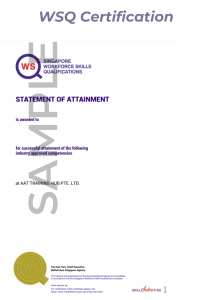
Upon fulfilling the course requirements with a minimum attendance rate of 75% and demonstrating proficiency in the assessments, candidates will be awarded a Certificate of Completion from AAT Training Hub, along with a nationally recognised
WSQ Statement of Attainment.

FAQs:

Artificial Intelligence (AI) is a branch of computer science focused on building systems capable of performing tasks that would typically require human intelligence. These tasks include learning, reasoning, problem-solving, understanding natural language, and perceiving and interpreting sensory information. AI systems aim to replicate and sometimes exceed human cognitive abilities, with applications in a wide range of fields, from robotics and healthcare to finance and transportation.

Key Types of Artificial Intelligence

  1. Reactive Machines: These AI systems are designed to perform specific tasks based on current inputs without storing past experiences or learning from them. They are limited in scope and are unable to adapt to new or unexpected scenarios. A classic example is IBM’s Deep Blue, which defeated the world chess champion in 1997.

  2. Limited Memory: This type of AI can learn from historical data to some extent. For instance, self-driving cars observe surrounding vehicles over time to make driving decisions. They don’t retain a permanent memory but analyze recent data to act and adapt to new situations.

  3. Theory of Mind: This is a more advanced type of AI that understands human emotions, intentions, and beliefs, enabling more sophisticated interactions. While still largely theoretical, advances in this area are ongoing in fields like human-robot interaction.

  4. Self-Aware AI: This is the most advanced form of AI, which would have consciousness, emotions, and self-awareness. Although still in the realm of science fiction, self-aware AI is often considered the ultimate goal for the future of AI research.

Core Components of AI

  • Machine Learning (ML): ML is a subset of AI that uses algorithms and statistical models to enable systems to improve their performance on a task through experience. Examples include supervised learning, unsupervised learning, and reinforcement learning.

  • Natural Language Processing (NLP): NLP enables machines to understand, interpret, and respond to human language. This component is essential in applications like virtual assistants, chatbots, and language translation services.

  • Neural Networks: Inspired by the structure of the human brain, neural networks consist of layers of interconnected nodes (neurons) and are foundational in deep learning, which powers image and speech recognition systems.

  • Computer Vision: This area allows AI systems to interpret and make decisions based on visual data, such as images and videos. It’s commonly used in facial recognition, object detection, and autonomous vehicles.

  • Robotics: Robotics integrates AI to create machines that can perform physical tasks autonomously or semi-autonomously. Applications include industrial automation, healthcare robotics, and self-driving cars.

Applications of Artificial Intelligence

  • Healthcare: AI helps in diagnosing diseases, developing personalized treatment plans, and even performing surgeries using robotic assistants.

  • Finance: AI is used in fraud detection, algorithmic trading, and personalized financial advice, among other applications.

  • Transportation: AI powers autonomous vehicles, optimizes logistics, and enhances traffic management systems.

  • Customer Service: Virtual assistants and chatbots use AI to provide customer support, answer questions, and manage requests efficiently.

AI continues to evolve, pushing boundaries in various sectors and leading to innovations that reshape our daily lives. Its development raises ethical considerations, particularly regarding data privacy, job displacement, and the need for human oversight to ensure beneficial and responsible AI deployment.

Having basic computer skills is sufficient, as the course is designed to be beginner-friendly and covers the fundamental aspects of programming.

Our trainers are experienced in teaching beginners, adept at delivering complex information in a patient and easily understandable manner, ensuring that you can keep up with the course.

Upon successful completion of the course, you will receive a Certificate of Completion from AAT Training Hub and a SkillsFuture WSQ Statement of Attainment (SOA). 

The SOA is a certification that identifies you as a competent person in the above topic and is recognised as one of our national qualifications

You can bring your own laptop for the course

You can indicate your interest here, call us at 62924804
or email us at admin@aattraininghub.com and we will get back to you as soon as possible.

WSQ Course

Any queries?
Email us: admin@aattraininghub.com
or
Whatsapp: +6590177049


Course Dates
Choose your preferred date
Start Date End Date Time Location Language Register
10-Sep
Thursday
11-Sep
Friday
09:00 to 18:00
Centrium Square
Serangoon Road ,S218108
English Book Now Batch 44068
21-Sep
Monday
22-Sep
Tuesday
09:00 to 18:00
Centrium Square
Serangoon Road ,S218108
English Book Now Batch 47392
24-Sep
Thursday
25-Sep
Friday
09:00 to 18:00
Centrium Square
Serangoon Road ,S218108
English Book Now Batch 47393
01-Oct
Thursday
02-Oct
Friday
09:00 to 18:00
Centrium Square
Serangoon Road ,S218108
English Book Now Batch 47394
★★★★★
4.8/5 from over 10284 verified learners

"The course is well-structured and conducted by experienced trainers."

- Lee T.

"Trainers were very supportive, I passed my certification smoothly."

- Mary L.

"Great hands-on practice with the . Highly recommend."

- Mustaq R.